
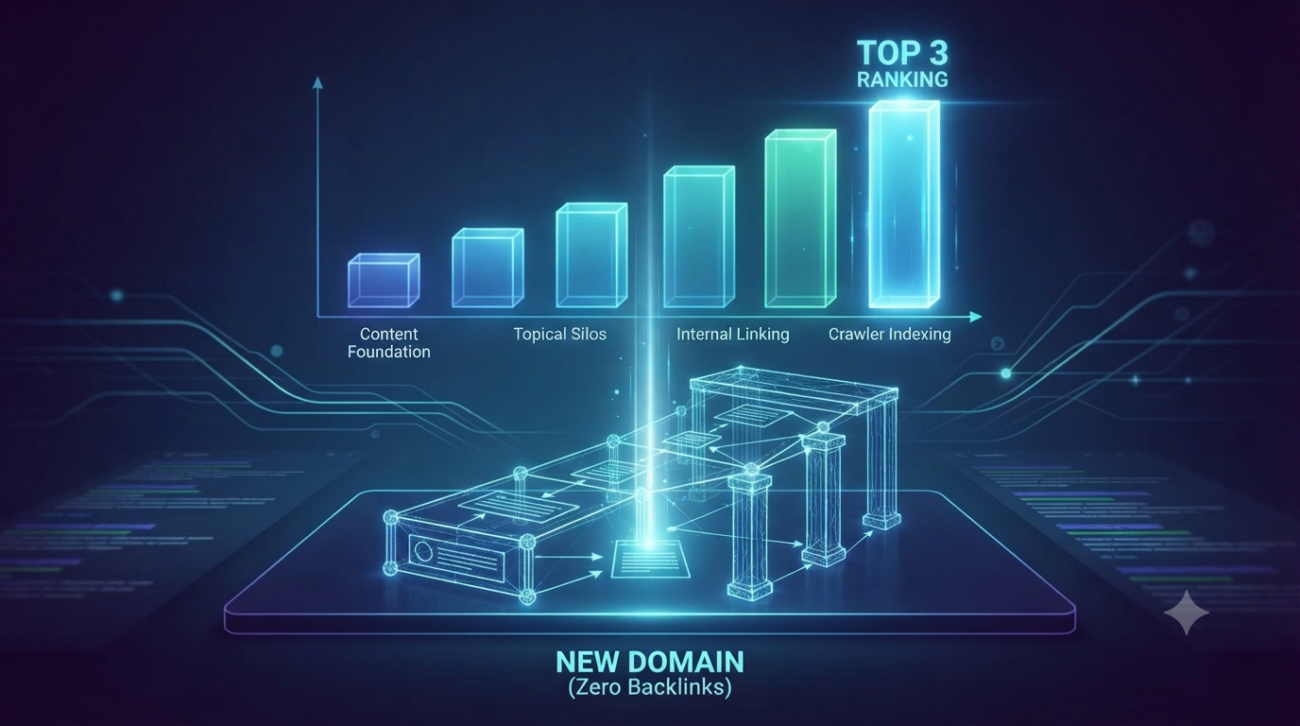
For over two decades, the search engine optimization (SEO) industry has bowed to a single undisputed ruler: the backlink. Traditional SEO dogma dictates that without a robust link-building campaign—spanning guest posting, digital PR, broken link building, and aggressive outreach—a brand-new domain stands virtually zero chance of capturing competitive search engine results page (SERP) real estate.
We are told that links are votes of confidence, and without them, Google treats a new website like a whisper in a hurricane.
But how much of this is immutable law, and how much is leftover folklore from an era when search engines relied heavily on primitive link-counting algorithms like PageRank?
With Google’s modern algorithm updates—heavily driven by advanced natural language processing (BERT, MUM), semantic search, and the Helpful Content System—search engines have grown remarkably adept at evaluating topical authority, context, and search intent satisfaction directly on the page.
To separate marketing myths from algorithmic reality, we launched a controlled, ground-up SEO experiment. Can a brand-new website achieve sustainable organic rankings and traffic relying solely on exceptional content, precise keyword research, meticulous internal linking, and technical SEO—without acquiring a single external backlink?
1. The Core Hypothesis
Our experiment is built around a singular, testable premise:
While backlinks act as an acceleration amplifier for established domains, they are no longer an absolute programmatic gatekeeper for visibility. In niche, long-tail, and information-heavy queries, structural on-page excellence and topical depth can entirely bypass the need for external link acquisition.
To prove or disprove this, we isolated the experiment from external variables. The target domain possesses zero historical authority, zero social media amplification, and—most importantly—zero external backlinks.
2. The 4-Phase Experimental Framework
To keep the study scientific and transparent, we structured our approach into four distinct, measurable phases:
[Phase 1: Baseline] ──> [Phase 2: Strategy] ──> [Phase 3: Analysis] ──> [Phase 4: Outcomes]
Phase 1: Establish the Baseline
- Objective: Understand where the website begins from absolute zero.
- Action Items: Documenting zero-state domain age, zero impressions, initial crawl budget behavior, indexation latency, and mapping out the target niche’s keyword landscape.
Phase 2: Apply the Strategy
- Objective: Build a self-sustaining ecosystem of content and internal architecture.
- Action Items:
- Publishing exhaustive, intent-matched pillar and cluster content.
- Executing semantic keyword clustering to capture long-tail variations.
- Deploying a rigorous internal linking silo to pass equity and guide crawlers.
- Ensuring lightning-fast core web vitals and flawless technical health.
Phase 3: Analyze the Results
- Objective: Separate assumptions from hard evidence using Google Search Console and analytics data.
- Action Items: Monitoring daily impressions, click-through rates (CTR), average position shifts, and query matching to see which topics index first without link reinforcement.
Phase 4: Share What Happened
- Objective: Total transparency.
- Action Items: Documenting the exact successes, algorithmic roadblocks, failures, and actionable takeaways for the broader SEO community.
3. The Execution Blueprint: How We Built a Zero-Backlink Strategy
Without the luxury of high Domain Authority (DA) or external votes of confidence, every single on-page element had to work twice as hard. Here is how the strategy was operationalized:
A. Hunting for Content Gaps and Long-Tail Keywords
We completely avoided high-competition head terms (e.g., “best CRM software” or “how to lose weight”). Instead, we focused heavily on long-tail, low-competition, high-intent informational queries.
- Why? Major authority sites often overlook hyper-specific queries or treat them superficially. By answering niche questions with exceptional depth, we positioned the site to capture low-hanging fruit where search engines desperately need relevant answers, regardless of domain age.
B. Building Tight Topical Silos
Instead of publishing a random assortment of articles across unrelated categories, we organized content into strict semantic silos.
- Every subtopic links back to a central pillar page, and pillar pages link down to supporting articles. This creates a clear hierarchy that signals deep topical expertise to Google’s crawlers, helping the algorithm understand what the site is about much faster than a scattershot publishing approach.
C. Relentless Internal Linking Architecture
When external authority is zero, internal link equity becomes your primary currency.
- We mapped out contextual links between related articles on day one. When a new article was published, older articles were updated to link to it, and vice versa. This ensured that crawl budget was conserved and that “link juice” (internal authority flow) continuously circulated through the site’s most critical conversion and traffic pages.
D. Prioritizing Search Intent Over Word Count
We abandoned arbitrary word-count goals. Every piece of content was crafted to answer the user’s query faster and more comprehensively than current top-ranking results. If a user wanted a quick calculator, we provided an embedded interactive solution. If they wanted a deep-dive explanation, we provided structured breakdowns, clear headings, and original insights.
4. Early Data & Observations
As the experiment progresses, several fascinating trends have emerged from our Google Search Console logs:
- Indexation Velocity is Slow, But Predictable: Brand-new URLs without external backlinks face initial crawler hesitation. However, leveraging direct XML sitemap submissions and forcing discovery through strong internal anchor text from already-indexed pages drastically reduced time-to-index.
- The Long-Tail Surge: Long-tail queries began capturing impressions and cracking the top 20 within 2 to 4 weeks of publication. Because search engines evaluate page relevance independently of external authority for niche questions, precise query matching wins early.
- The Authority Ceiling: The real test occurs when pushing from the second page into the top 3 positions for medium-competition terms. Here, domain-level trust signals and user engagement metrics begin to heavily influence rankings, representing the exact boundary where a zero-backlink strategy faces its toughest friction.
5. Key Takeaways & Interim Conclusions
While this SEO experiment is ongoing, the data gathered thus far challenges traditional marketing narratives and offers actionable lessons for bootstrap founders, content creators, and modern SEOs:
- Backlinks Are Accelerators, Not Gatekeepers: Think of backlinks as rocket fuel—they help you reach the top faster, but they are not the engine itself. Great content and tight architecture are the engine that gets the vehicle moving.
- Topical Authority Beats Random Publishing: Publishing 50 deeply interconnected articles on a tight niche yields exponentially better results than publishing 200 random articles across 10 different industries.
- Architecture is Everything: In the absence of external links, your internal linking structure is the scaffolding that holds your entire SEO house upright.
Final Thoughts
The dogma of “you cannot rank without backlinks” is increasingly outdated. While building links certainly makes the SEO climb easier and faster, a meticulous combination of topical depth, flawless technical execution, and rigorous internal linking can break through the noise and capture valuable organic traffic from scratch.
