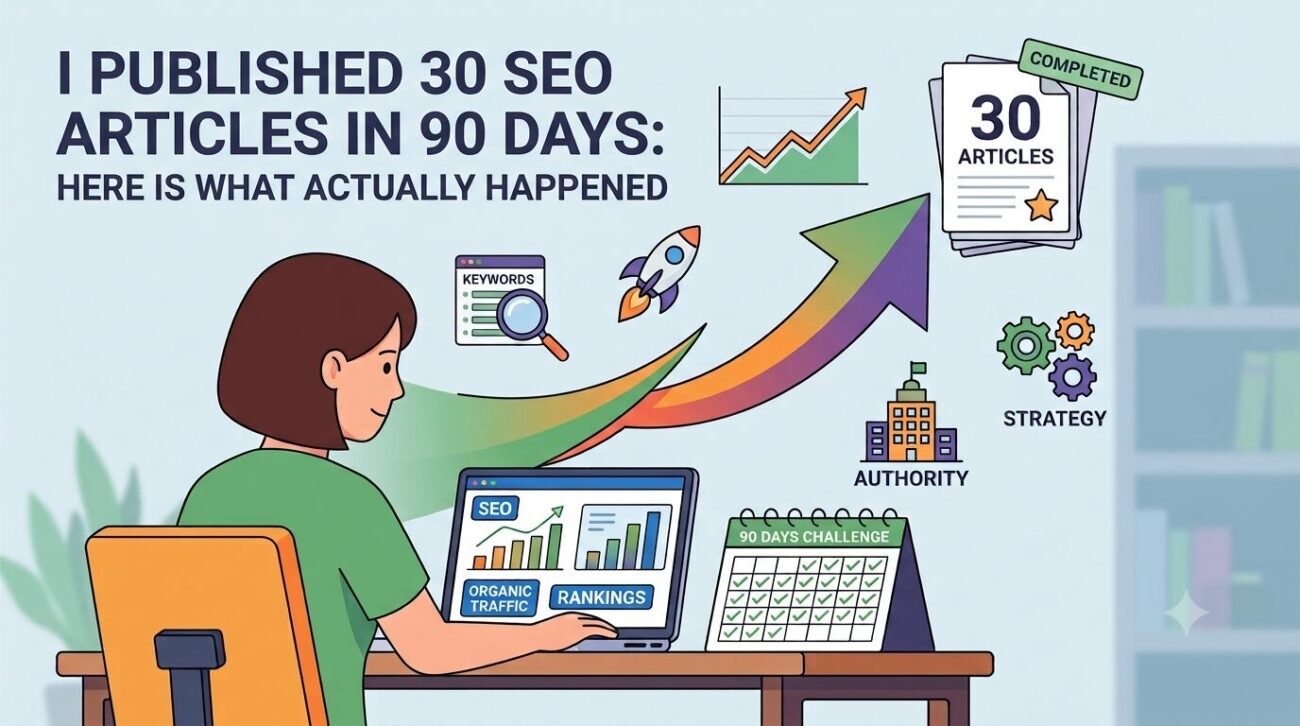
Publishing 30 SEO articles in 90 days sounds like a simple challenge.
One article every three days. That is all.
At least, that is how I looked at it before I started.
I had read countless articles about SEO content strategies, topical authority, keyword research, content velocity, internal linking, and the importance of publishing consistently. Almost every SEO blog seemed to recommend some version of the same strategy: publish high-quality content regularly, target relevant keywords, build topical authority, and wait for Google to reward your efforts.
So I decided to test the idea myself.
For 90 days, I focused on publishing 30 SEO articles on my digital marketing blog. The goal was not to publish random content simply to increase the article count. I wanted to target search queries related to digital marketing, SEO, blogging, website growth, online tools, and other closely related topics.
The experiment was simple.
I would publish 30 articles in 90 days, optimize them for search engines, connect them with internal links, and monitor what happened.
I expected traffic to grow significantly.
The reality was more complicated.
Some articles started getting impressions within weeks. A few began ranking for keywords I had not specifically targeted. Several articles received almost no traffic at all. One or two articles performed much better than expected, while other articles that seemed equally well-researched remained practically invisible.
After 90 days, I had more content, more search impressions, more data, and a much clearer understanding of what publishing SEO content actually does.
The biggest lesson was this: publishing 30 articles is not the same as building 30 successful pages.
The Situation Before I Started
Before beginning the experiment, the website was relatively small.
It had some existing content, but it was not a high-authority website with thousands of backlinks or a large audience. The website had limited organic traffic and was still trying to establish itself in a competitive digital marketing space.
The approximate starting point looked like this.
The website was receiving roughly 100 to 150 organic visits per month. Search impressions were low, most keywords were ranking outside the top 20 results, and the website had very few strong backlinks.
The site also did not have a large email list or a massive social media audience that could immediately send traffic to every new article.
This is important because the results of an SEO experiment depend heavily on the starting point.
A website with high authority, thousands of referring domains, and an established audience can publish an article and receive traffic almost immediately.
A small website cannot necessarily do the same.
For a new or relatively small website, publishing an article is often the beginning of the process, not the end.
My Goal Was to Publish 30 Articles
The target was straightforward.
I wanted to publish 30 SEO-focused articles within 90 days.
That meant approximately 10 articles per month.
The topics were selected around a few broad categories, including search engine optimization, content marketing, blogging, digital marketing tools, website growth, keyword research, and beginner-friendly online marketing strategies.
I did not want every article to target a massive keyword with tens of thousands of monthly searches.
That would have been unrealistic.
Instead, I tried to combine different types of content.
Some articles targeted long-tail keywords with lower competition. Some were designed to answer specific questions. Others were broader guides that could potentially attract traffic from several related search queries.
The idea was to create a collection of useful content rather than depend on one article becoming successful.
At least, that was the theory.
The First 30 Days Were Surprisingly Quiet
The first month was probably the most difficult part of the experiment.
I published approximately 10 articles during the first 30 days.
The initial excitement was high. Every time I published a new article, I expected Google to discover it quickly and start sending visitors.
That did not happen.
Some articles were indexed within a reasonable amount of time. Others took longer. Even after being indexed, many pages received almost no clicks.
The website began receiving more impressions, but the increase in traffic was much smaller.
This was one of the first important lessons.
Impressions and clicks are completely different things.
An article can appear in search results hundreds or thousands of times without receiving significant traffic if it ranks on the second or third page.
For example, a page might receive 1,000 impressions during a month but only 10 clicks. That means the page is technically appearing in search results, but it is not visible enough to attract substantial traffic.
During the first 30 days, many of the new articles appeared to be in this stage.
They were being discovered.
They were being tested in search results.
But they were not yet generating meaningful traffic.
The website was showing signs of movement, but the results were not dramatic.
The Second Month Showed the First Signs of Progress

The second month was more interesting.
By this point, I had published approximately 20 articles.
Some of the first articles had been online for several weeks, which gave Google more time to understand their content and determine where they belonged in search results.
A few pages started moving from positions outside the top 50 into the top 30.
Some appeared between positions 20 and 40 for several related keywords.
This still did not generate a huge amount of traffic, but it was encouraging.
The most interesting discovery was that some articles began ranking for keywords I had not intentionally targeted.
This happens frequently with well-structured content.
You may write an article targeting one primary keyword, but Google may understand that the article is relevant to dozens of related phrases.
For example, an article about SEO content planning might begin appearing for searches related to content calendars, blog planning, SEO strategy, content ideas, and keyword research.
This is one reason I believe that focusing too narrowly on one exact keyword can be limiting.
The goal should not simply be to repeat one phrase throughout an article.
The goal should be to create a page that genuinely covers the subject.
By the end of the second month, organic traffic had increased modestly.
Instead of receiving approximately 100 to 150 organic visits per month, the website was now closer to around 250 to 350 monthly organic visits, depending on the period being measured.
That was not explosive growth.
However, it was progress.
More importantly, the website was beginning to generate data.
I could see which topics were receiving impressions, which pages had better click-through rates, and which articles were completely failing to gain visibility.
The Third Month Was When the Experiment Became Useful
By the time I reached the third month, all 30 articles had been published.
This was the point at which I stopped focusing only on the number of articles published.
Instead, I began looking at the quality of the results.
The 30 articles were not performing equally.
Some pages were clearly outperforming the rest.
A small group of articles generated a significant portion of the traffic from the new content.
This was one of the most important lessons of the entire experiment.
SEO results are rarely distributed evenly.
You can publish 30 articles and discover that perhaps five articles are responsible for most of the organic traffic.
Another ten articles may be receiving impressions but very few clicks.
The remaining articles may be barely visible.
This does not necessarily mean the underperforming articles are useless.
Some pages may need more time.
Others may need better internal links.
Some may need improved titles and meta descriptions.
Some may be targeting keywords that are simply more competitive than originally expected.
And some may genuinely be poor opportunities.
The important thing is to identify the difference.
The Results After 90 Days

After 90 days, the website had approximately 30 new SEO articles.
Organic traffic had increased from roughly 100 to 150 monthly visits at the beginning of the experiment to approximately 500 to 700 monthly organic visits by the end of the period.
The exact numbers varied depending on how the traffic was measured, but the overall trend was positive.
Search impressions increased significantly.
The website also began ranking for a larger number of keywords.
However, the results were not as spectacular as some SEO case studies make them appear.
There was no overnight explosion.
There was no single article that suddenly generated thousands of visitors.
There was no guarantee that publishing another article would automatically increase traffic.
The growth was gradual.
Some of the most important results were not immediately visible in traffic numbers.
The website had more indexed pages.
It had more opportunities to appear in search results.
It had more internal linking opportunities.
It had more data about what the audience was interested in.
And it had a stronger foundation for future content.
This is something that is often ignored when people discuss SEO.
The first 90 days may be less about maximizing traffic and more about creating enough content and data to understand what has the potential to work.
Only a Few Articles Became Clear Winners
The 30 articles could roughly be divided into different performance groups.
A small number became the strongest performers.
These articles began ranking for multiple keywords and consistently generated organic traffic.
Another group performed moderately.
These pages received impressions and occasional clicks but were not yet attracting significant traffic.
The final group performed poorly.
Some articles had very few impressions.
Others ranked for keywords that had almost no search demand.
A few were probably too competitive for the current authority of the website.
This was a valuable reminder that content quality alone does not guarantee rankings.
An article can be well-written and still fail to attract organic traffic.
Search demand matters.
Competition matters.
Website authority matters.
Search intent matters.
Internal linking matters.
The quality of competing pages matters.
Even the timing of the search query can matter.
Publishing a good article is necessary, but it is not always sufficient.
The Biggest Mistake Was Expecting Every Article to Work

If I had to identify my biggest mistake, it would be expecting every article to perform.
I initially viewed the 30 articles as 30 separate chances to generate traffic.
In reality, each article had a different probability of success.
Some keywords were clearly better opportunities than others.
Some topics had a much larger audience.
Some pages matched search intent better.
Some articles were easier to differentiate from existing search results.
The lesson is simple.
You should not judge your SEO strategy only by the number of articles published.
You should also evaluate the quality of the opportunities you are targeting.
Publishing 30 articles targeting extremely competitive keywords may produce worse results than publishing 10 highly targeted articles aimed at realistic long-tail opportunities.
Quantity can help.
But quantity without strategy can become a content archive that nobody visits.
Internal Linking Made a Bigger Difference Than Expected
One of the most useful parts of the experiment was improving internal links between related articles.
When new content was published, I tried to connect it with relevant existing content.
For example, an article about keyword research could link to an article about SEO content planning.
An article about content marketing could link to a guide about blog strategy.
This created stronger relationships between pages.
Internal linking is not a replacement for high-quality content or external authority, but it helps search engines understand the relationship between pages.
It also helps users discover more content.
One article can lead to another.
A visitor who originally arrives through a search query may end up reading multiple pages.
Over time, this creates a more useful website.
The important thing is that internal links should be natural.
Adding dozens of unrelated links simply for SEO purposes does not create a good user experience.
The links should genuinely help the reader continue learning about the subject.
Updating Content Became More Important Than I Expected
Before this experiment, I was primarily focused on publishing new articles.
After publishing 30 articles, I realized that creating new content is only one part of SEO.
The next phase is optimization.
Some articles were already receiving impressions but had poor click-through rates.
These pages could potentially benefit from better titles and meta descriptions.
Other pages were ranking on the second page of Google.
These might benefit from clearer explanations, better structure, additional examples, improved internal links, or more complete coverage of the topic.
This is where the real opportunity begins.
A page ranking at position 50 has a long way to go.
A page ranking at position 12 may only need a relatively small improvement to reach the first page.
Therefore, not all articles deserve equal attention.
The best strategy is often to identify pages that already show signs of potential and improve those first.
What I Would Do Differently If I Started Again

If I were starting the 90-day experiment again, I would spend more time evaluating keywords before writing.
I would not simply ask whether a keyword has search volume.
I would ask whether the website has a realistic chance of ranking for it.
I would study the search results more carefully.
Are the top-ranking pages from extremely powerful websites?
Are the results dominated by major brands?
Are there smaller websites ranking on the first page?
Does the search intent match the type of content I want to create?
These questions matter.
I would also create stronger content clusters.
Instead of publishing completely independent articles, I would plan groups of related content.
For example, I might create a main guide about SEO and then publish supporting articles about keyword research, technical SEO, content optimization, internal linking, and link building.
This creates a more connected website structure.
I would also reserve time every week for updating existing content.
Publishing new content should not consume 100 percent of the available time.
A website can grow by creating new pages, but it can also grow by improving pages that already exist.
Was Publishing 30 Articles Worth It?
Yes.
But not because every article became successful.
Publishing 30 articles was valuable because it generated information.
I learned which topics attracted impressions.
I learned which headlines received more clicks.
I learned which types of keywords were too competitive.
I learned which content formats performed better.
I learned that some articles require patience.
I also learned that SEO is not a vending machine.
You cannot simply insert 30 articles and expect traffic to come out.
The process is more complicated.
You publish.
You wait.
You observe.
You analyze.
You improve.
You publish more.
Then you repeat the process.
The 90-day experiment gave me a stronger foundation than I had before starting.
The website had more content, more search visibility, and more opportunities to grow.
The traffic increase was real, but it was not magical.
It was gradual and uneven.
That may not sound as exciting as a case study claiming that a website went from zero to 100,000 visitors in three months.
However, it is probably closer to the reality experienced by many small websites.
The Biggest Lesson From the Experiment
The biggest lesson is that publishing 30 SEO articles is not the final goal.
It is the beginning of a feedback loop.
You publish content to create opportunities.
Then you use search data to understand what is working.
You improve the pages that show potential.
You create more content around topics that attract interest.
You strengthen the relationships between related pages.
Over time, the website becomes more comprehensive and more competitive.
The first 90 days may not produce spectacular traffic numbers.
For a small website, that is normal.
SEO often takes longer than expected, especially when the website has limited authority and operates in a competitive niche.
The most important thing is to avoid confusing slow growth with failure.
At the same time, patience should not become an excuse for refusing to improve.
If an article receives no impressions after a reasonable period, investigate why.
If an article receives impressions but no clicks, improve the title and description.
If an article ranks on page two, look for ways to make it more useful and comprehensive.
If an article is targeting an impossible keyword, consider whether the strategy needs to change.
Publishing consistently is important.
But publishing, analyzing, and improving is much more powerful.
After publishing 30 SEO articles in 90 days, I did not discover a secret formula for guaranteed rankings.
What I discovered was more useful.
SEO is a long-term process of creating useful content, understanding search intent, collecting data, and making better decisions over time.
Thirty articles did not transform the website overnight.
But they gave the website more chances to be discovered.
They revealed what worked and what did not.
They created a foundation for future growth.
And most importantly, they proved that the real value of an SEO publishing challenge is not simply the number of articles you publish.
The real value is what you learn from those articles after they enter the search results.
That is what actually happened.
The results were positive, but gradual.
Some articles succeeded.
Some struggled.
Some may need months of improvement before reaching their potential.
And that is probably the most honest lesson of all.
If you are planning your own 90-day SEO content challenge, do not measure success only by whether you reach your publishing target.
Measure how much you learn.
Measure how many pages begin receiving impressions.
Measure how many keywords you start ranking for.
We also have some other SEO Oriented articles that you might like.
Measure whether your content becomes more useful and better connected.
Because SEO growth rarely happens from one article.
It usually happens when dozens of small improvements begin working together.
